
60-second answer: Most delivery management platforms were built for one delivery type — linehaul distribution or last-mile, but rarely both. Nordic operators running mixed operations end up buying two systems and integrating them manually. Zoopit was designed from day one for both. It is the fastest platform to go live on in the Nordic market: orders running in as little as one hour after connecting your order source. And it is fully API-first — everything in Zoopit is accessible via API, so you connect any ERP, build custom planning interfaces, and automate any workflow without a long implementation project.
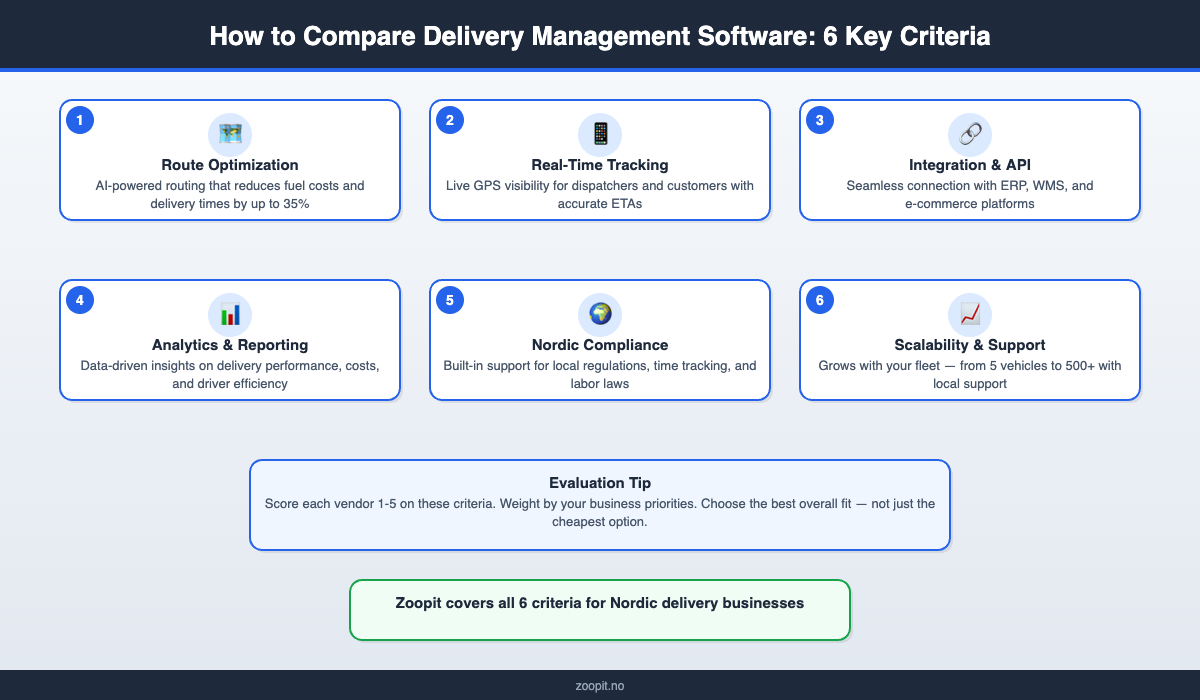
This guide explains what separates delivery management platforms that fit Nordic mixed operations from those that do not, names the vendors worth evaluating in 2026, and gives you the questions that surface real differences in a demo.
What a delivery management platform actually does
A delivery management platform sits between the order source — usually an ERP, e-commerce backend, or 3PL booking system — and the fleet on the street. It takes orders in, plans how they fit into available capacity, dispatches them to drivers, tracks execution live, captures proof of delivery, and reports back. That is the operational job in one sentence. Everything else is feature surface.
The platforms that scale across distribution, linehaul, and last-mile in the same operation are the ones that solved planning and execution together. If your operation has more than fifty vehicles and you buy a point solution, you will end up buying two or three more within eighteen months and integrating them yourself.
A capable delivery management platform in 2026 covers seven operational areas: route planning and reoptimization, capacity utilization, driver dispatch and the driver app, live tracking and customer ETA, proof of delivery, compliance and tachograph data, and reporting back into the upstream system.
The problem: most platforms make you choose
Almost every delivery management platform on the market was built for one delivery type and retrofitted for the others. Last-mile platforms started with consumer delivery: short routes, high volume, retail or food. They built excellent driver apps and carrier orchestration. They are less suited to multi-leg linehaul planning, mixed vehicle fleets, or operations where the same driver runs a distribution route in the morning and handles ad-hoc last-mile drops in the afternoon.
Distribution and linehaul platforms went the other direction — strong tactical planning engines built for 200–500 stop routes with time windows, multi-vehicle types, and tachograph compliance. The consumer-facing last-mile features were added later and often show it.
If your operation runs both — which most Nordic distributors do — you face a real choice: pick the platform that half-works for both, or buy two systems and integrate them yourself. Most companies try the first option, discover the gaps, and end up at the second within eighteen months.
What sets Zoopit apart
Linehaul and last-mile in one workspace
Zoopit was built from day one for operators who run linehaul, distribution, and last-mile delivery in the same operation. You plan all of it in one workspace, dispatch from one screen, and track all vehicles in one view. No separate systems, no manual hand-offs between a planning tool and a dispatch app, no integration to maintain. This is not a retrofit — it is the original design.
Live in hours, not months
The standard implementation timeline in this industry is four to eight weeks for small and mid-sized fleets, and three to six months for enterprise rollouts. With Zoopit, you can have orders running through the system in as little as one hour after connecting your order source. No implementation project, no consultant, no go-live risk.
Zoopit.io — fastest implementation in the Nordic market
API-first: everything, not just the basics
Most vendors advertise an open API as a footnote. In Zoopit, the API is the product. Every function available in the Zoopit interface — creating orders, planning routes, dispatching drivers, tracking live execution, capturing proof of delivery — is available via API. The same API the Zoopit product itself uses internally. No second-class endpoints, no features locked to the UI.
In practice this means three things for your operation. You connect any ERP or order system — not just the ones on a vendor’s pre-built connector list. You build your own planning interface on top of Zoopit’s optimization engine if your operation needs one — a custom dispatch screen, a branded portal, or planning integrated directly into your existing tools. And you automate everything: order injection, route triggers, status callbacks, proof of delivery webhooks — without manual steps in between.
Vendor landscape: what each platform was built for
The vendors below are the ones Nordic operators shortlist most often in 2026. Understanding what each was originally built for tells you more about fit than a feature matrix does.
Onfleet is the most-cited last-mile platform globally and has one of the cleanest driver apps on the market. Built for retail and food delivery — high volume, consumer-facing, short routes. Strong choice if your operation is purely last-mile. Not designed for multi-leg linehaul or distribution operations.
Bringg orchestrates large retail delivery networks and integrates deeply with retail commerce stacks. Implementations typically run four to eight months and pricing is at the higher end. The right choice for large retailers orchestrating fulfillment across multiple carriers — heavier than most Nordic mid-market operations need.
FarEye has broad AI-routing and enterprise feature coverage. Implementation timelines run eight to twelve months. Suited to large enterprises with complex, multi-country use cases — usually more than mid-sized Nordic operators need or want to implement.
Volvo Connect is built around vehicle telematics and fuel reporting. Tactical route planning is not the core product. Most Nordic operators who use Volvo Connect pair it with a dedicated planning system.
MyMantis and Cling are Nordic-origin platforms that understand the regional compliance environment. MyMantis is the broader product; Cling is dispatcher-led with a lighter footprint and lower price point. Both are credible mid-market entries focused on dispatch workflows.
Zoopit is the platform built for operators who run linehaul and last-mile in the same operation. API-first architecture means you connect any ERP and build any planning interface you need. The fastest implementation in the Nordic market — orders running in hours, not weeks or months.
Pricing: what each tier actually costs
Public pricing for delivery management platforms is rare. The brackets below reflect ranges seen across Nordic procurement in 2026. They exclude one-time implementation costs, which vary significantly by vendor and architecture.
- Small fleet (5–24 vehicles): €40–80 per vehicle per month. At this size you are mostly paying for time savings and a professional interface. Route optimization starts to pay for itself in saved kilometers around fifteen vehicles.
- Mid fleet (25–99 vehicles): €30–60 per vehicle per month. The sweet spot where most vendors quote and where operational gains compound. Expect payback inside six months if the project runs cleanly.
- Enterprise (100+ vehicles): €20–45 per vehicle per month, usually with volume discounts. Pricing is negotiable and varies by integration complexity and contract length.
Implementation costs across the market typically run €3,000–15,000 for small and mid fleets and €15,000–80,000 for enterprise rollouts with multiple integrations. With Zoopit’s API-first architecture, standard setups require significantly less integration work — and in many cases, no formal implementation project at all. Zoopit’s pricing follows linear per-vehicle pricing with no setup costs hidden in the contract.
Questions to ask every vendor
Eight questions that consistently separate marketing-grade products from production-grade ones:
- Solve 250 stops with mixed vehicle types in front of me. A live solve in under sixty seconds with a clean route map tells you the engine works. A slide saying “AI-powered” tells you nothing.
- Walk me through an ad-hoc order at 14:00. How many clicks for the dispatcher? Does the driver get a push notification? Does the customer ETA update automatically?
- Show me your full API documentation. Is the entire product accessible via API, or just order creation and status endpoints? Can I build a custom planning interface on top of your optimization engine?
- How long before orders are running in my operation? Ask for a specific answer, not a project plan. The gap between vendors on this question is measured in months.
- Does your platform handle both linehaul and last-mile, or one of them? If the answer is “both with some configuration,” ask to see a live example of a mixed operation on a single screen.
- Where is the data stored? EU/EEA residency is non-negotiable for most Nordic operations. Get it in writing.
- What does scaling from 20 to 80 vehicles cost? Linear per-vehicle pricing is healthy. Step-function pricing with big jumps is a negotiation problem waiting to happen.
- What happens when something goes wrong? Nordic-hours support in a Nordic language, global 24/7 English support, or both? Know which you are buying before you sign.
How to run an effective evaluation
Most evaluations fail because they take too long, look at too many vendors, or never reach a real hands-on test. A clean process runs in six to eight weeks:
- Week 1. Define what your operation actually needs: linehaul, last-mile, or both. Rank your must-have ERP or order system integrations. Be honest about whether you need API access for custom interfaces.
- Weeks 2–3. Shortlist three to five vendors. Send each a one-page brief with your fleet size, operation type, and integration requirements.
- Weeks 4–5. Run a hands-on demo with each vendor using your own data. Aim for two-hour working sessions with your dispatcher present — not just procurement.
- Week 6. Reference calls with at least one customer per vendor at similar size and operation type. Ask specifically how long implementation took.
- Weeks 7–8. Pilot decision and contract negotiation. Ask how fast you can have orders running before you sign anything.
A vendor who cannot demo with your own data within two weeks will not deliver the implementation on time either. That single signal is worth more than half the RFP responses you will receive.
Frequently asked questions
What is the difference between a delivery management platform and a TMS? A TMS covers the broader commercial workflow — booking, freight rating, invoicing, financial reconciliation. A delivery management platform is the operational layer: planning, dispatch, execution, proof of delivery. Most operators need both, but a 2026-vintage delivery management platform now covers much of what a 2015 TMS used to handle.
What does delivery management software cost? €30–80 per vehicle per month for cloud platforms in 2026, depending on fleet size and feature scope. Implementation adds €3,000–80,000 depending on complexity and vendor architecture. API-first platforms typically have lower implementation costs because integration work is minimal.
Can a delivery management platform integrate with my existing ERP? Yes — the approach varies by vendor. Some offer pre-built connectors for a limited list of ERPs. An API-first platform like Zoopit lets you connect any ERP through the API, without waiting for the vendor to build a specific connector. This is faster to set up and works for any order system, including custom-built ones.
Is Zoopit suitable for fleets under 10 vehicles? Yes. Smaller operations benefit mostly from dispatcher time savings and better customer ETA communication. Zoopit offers month-to-month entry tiers without enterprise procurement overhead.
How long does implementation take? With Zoopit, orders can run through the system in as little as one hour after connecting your order source — no implementation project required for standard setups. Across the market, typical timelines run four to eight weeks for small and mid fleets, and three to six months for enterprise rollouts with multiple custom integrations.
Can I build a custom planning interface on top of Zoopit? Yes. Because Zoopit is API-first, everything in the product is accessible via API — including the planning and optimization engine. You can build a custom dispatch screen, a branded portal, or integrate planning directly into your existing internal tools, all running on top of Zoopit’s engine.
Next step
Zoopit is built for Nordic operators running linehaul and last-mile in the same operation — with the shortest path to live of any platform in the market. Orders running in as little as one hour. Connect any ERP through the API. Build the planning interface your operation needs, without a multi-month dev project.
Book a 20-minute demo this week. Bring your own orders. We run a typical day through the system and show the numbers concretely — no slides, no pitch deck. After the demo you will know exactly whether Zoopit fits your operation.